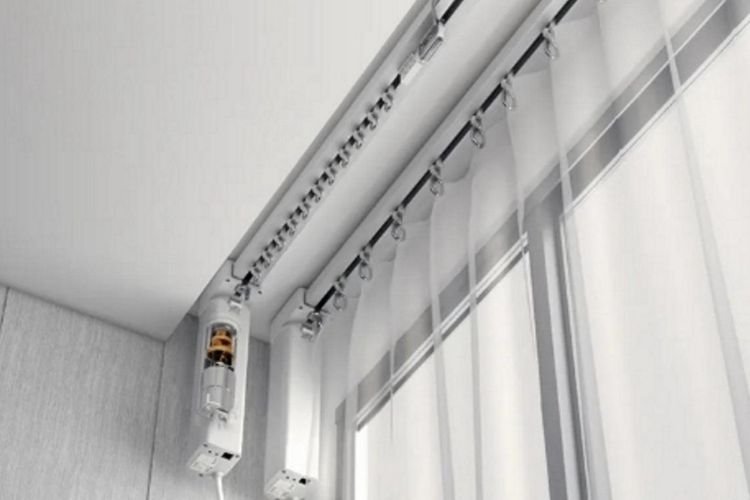
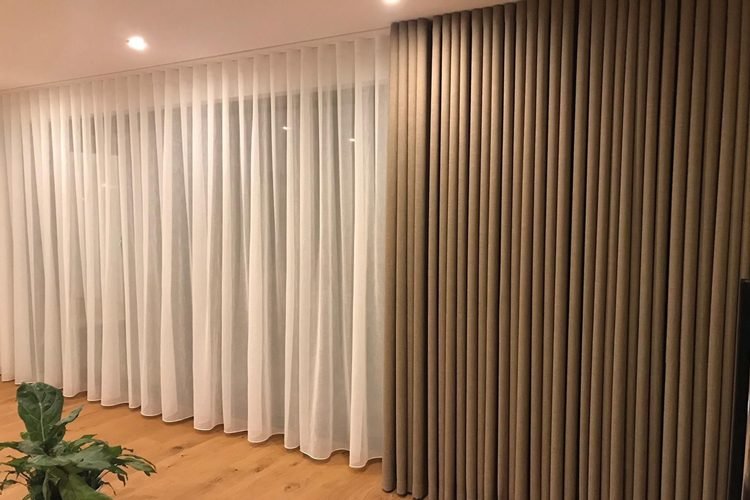
To measure for curtains, run a steel tape across the full width of your pole or track (not the window), then measure the drop from the top of the pole down to where you want the fabric to end. Multiply the pole width by 2 to 2.5 for a full, gathered look.
That single rule covers most windows, and the rest of this guide walks you through it slowly, in both centimetres and inches, with practical examples inspired by real blinds and curtains Dubai installations.
Getting curtain measurements right is the difference between curtains that pool beautifully on the floor and curtains that hang short and thin. The good news for beginners: you only need three numbers and one tape measure.
What You Need Before You Start

A short kit makes this job quick and accurate.
- A steel tape measure (a fabric one stretches and gives false readings)
- A step ladder for tall windows
- A pencil and paper, or a notes app
- Your curtain pole or track, ideally already fitted to the wall
One tip before anything else: your measuring tape should be metal, not cloth. A cloth tape sags over a wide window and can add several centimetres of error, especially when working with Curtains in Dubai where larger window sizes are common. Fit your pole first if you can, because every measurement below depends on its position.
How To Measure Curtain Perfectly | Quick Steps

Here is the whole process in five steps. Each step has its own detailed section further down.
- Fit your pole or track 15cm (6 inches) above the window and 15cm wider on each side.
- Measure the full width of the pole between the finials.
- Multiply that width by 2 (standard) or 2.5 (luxury) to find your total fabric width.
- Measure the drop from the top of the pole to your chosen end point.
- Split the total width across the number of panels you want.
That sequence works for living rooms, bedrooms, and kitchens alike. The detail in each step is where beginners go wrong, so the sections below slow each one down.
How To Measure Curtain Width | Easy Steps

Curtain width comes from the pole, not the window. Measure the full length of your pole or track between the two finials (the decorative end caps), then multiply by your fullness ratio. A 150cm pole at standard 2x fullness needs 300cm of curtain across both panels.
Your curtain width should never match the bare window width, or the curtains will look flat and starved when closed – especially for blackout curtains, which need extra fullness to block light properly. The pole itself is your measuring line because that is the true span the fabric must cover.
Here is how the width works in practice:
- Measure the pole, finial to finial. Your tape runs the full distance between the end caps. Do not include the finials themselves.
- No pole yet? Take the window width and add 30 to 40cm (12 to 16 inches) to allow the curtains to clear the glass on each side.
- Apply your fullness. Standard fullness is the pole width times 2. A luxury look is the pole width times 2.5.
- Divide across panels. Most windows use a pair, so the total fabric width splits in two for each panel.
Worked example (centimetres): Your pole measures 160cm. At 2x fullness, you need 320cm of fabric in total. A pair of curtains means each panel is 160cm wide.
Worked example (inches): Your pole measures 60 inches. At 2x fullness, you need 120 inches of fabric in total. Each panel in a pair is 60 inches wide.
How To Measure Curtain Length (Drop)

Curtain length, also called the drop, runs from the top of the pole down to where you want the fabric to stop. Always measure each window on its own, because floors and sills are rarely perfectly level. The three common end points are the sill, just below the sill, and the floor.
Your curtain drop depends on the curtain heading and your chosen style. Where you start the tape changes with the heading type:
- Eyelet curtains. Your tape starts at the very top of the pole, since the fabric sits slightly above it.
- Pencil pleat and tab top curtains. Your tape starts where the hooks or rings will sit, usually just under the pole.
- End point. From that start, run the tape down to the sill, the apron line, or the floor.
A quick rule for floor-length panels: stop the tape 1cm above the floor so the curtains skim the surface without dragging.
Worked example (centimetres): The top of your pole sits 230cm above the floor. For floor-length curtains, your drop is about 229cm, leaving a 1cm gap.
Worked example (inches): The top of your pole sits 90 inches above the floor. For floor-length panels, your drop is roughly 89.5 inches.
Window Dressing
Curtain Size Calculator
Enter your pole width and drop. You will get the right ready-made size for both a standard and a fuller, luxury look, in centimetres or inches.
Your recommended sizes
Standard look · 2x fullness
Luxury look · 2.5x fullness
Curtains are sold in pairs. Each size shown is the width of one panel. Recommendations are a guide; fabric weight, heading type, and fitting can affect the final look, so check your measurements before ordering.
How To Add Fullness For The Right Look

Fullness is the ratio of fabric width to pole width. It decides how gathered and rich your curtains look when closed. Standard fullness is 2x the pole width, while a luxury, hotel-style finish uses 2.5x. Less than 2x reads as flat and sparse.
The right fullness ratio depends on your room and fabric weight. This table shows the four common levels and when each one suits.
| Fullness | Fabric vs pole | Best for |
| 1.5x | Pole width times 1.5 | Frame-only panels you never close |
| 2x | Pole width times 2 | Most living rooms and bedrooms (the standard) |
| 2.5x | Pole width times 2.5 | Master bedrooms and formal lounges |
| 3x | Pole width times 3 | Sheer voiles and very light fabrics |
Heavier fabrics need a little less fullness because they fold thickly on their own. Light voiles need more, so reach for 2.5x or 3x to avoid a thin look.
Inside Mount vs Outside Mount

An inside mount fits the curtains inside the window recess, so you measure the recess itself. An outside mount fits them on the wall above and around the window, so you measure wider and taller than the glass. Outside mounting makes a window look bigger and blocks more light.
Your mounting position shapes how you measure:
- Inside (recess) mount. Your width is the inside recess measurement, and your drop runs from the top of the recess to the sill. The recess must be deep enough for the bracket.
- Outside (wall) mount. Your width is the window plus 15cm (6 inches) on each side, and your drop starts higher, often 15cm above the frame.
Most homes use an outside mount because it gives fuller coverage and a taller, grander window line.
Curtain Pole vs Curtain Track | How Measuring Differs

For a pole, you measure between the finials and ignore the decorative ends. For a track, you measure the full track length, because the gliders run the entire run with no finials to subtract. Tracks also sit closer to the ceiling, which changes your drop start point.
A curtain track suits bay windows and ceiling fixings, while a pole suits straight runs and a decorative finish. The measuring difference is small but easy to miss:
- Pole. Your width is finial to finial. Your drop usually starts at the top of the pole for eyelets.
- Track. Your width is the full track length, end to end. Your drop starts from the track itself or the top of the heading tape.
- Outside the recess. For a wall-fixed track, add 10cm (4 inches) on each side so the closed curtains block side light.
If you are buying a track from scratch, size it the same way as a pole: window width plus 15cm each side for good overlap.
Where Should Curtains End? Curtain Length Styles

Curtains can end at the sill, just below it, at the floor, or in a pool on the floor. Floor-length is the most popular because it suits almost every room. Your choice sets the exact drop number you measure to.
These four floor-length curtains alternatives each create a different feel:
| Style | Where it ends | Look |
| Sill length | 1cm above the sill | Neat, practical, good for kitchens |
| Apron length | 15cm below the sill | Relaxed, with better insulation |
| Floor length | 1cm above the floor | Elegant and the most popular |
| Puddle | 2 to 7cm on the floor | Dramatic, hotel-style, for low-traffic rooms |
Sill and apron lengths work well above radiators and kitchen counters. Floor and puddle lengths suit bedrooms and lounges where the fabric can hang long.
Ready-Made vs Made-To-Measure Curtains

Ready-made curtains come in fixed standard sizes and ship fast and cheap. Made-to-measure curtains are cut to your exact window and cost more but fit perfectly. Pick ready-made when your window is a standard size, and made-to-measure when it falls between sizes.
Standard ready-made curtains are sold by width and drop, often in pairs. This comparison helps you choose:
| Feature | Ready-made | Made-to-measure |
| Sizing | Fixed standard sizes | Any size, cut to your window |
| Price | Lower, budget-friendly | Higher |
| Delivery | A few days | One to several weeks |
| Best for | Standard windows | Odd shapes and large windows |
If your window sits between two ready-made sizes, round up to the larger one and let the extra fabric add fullness.
Common Curtain Measuring Mistakes To Avoid
Most measuring errors trace back to a handful of habits. Watching for these saves you a return or a refit.
- Measuring the window instead of the pole. Your fabric width comes from the pole span, so this leaves curtains too narrow.
- Forgetting fullness. A pole-width pair with no multiplier hangs flat and never looks closed.
- Using a cloth tape. A fabric tape stretches and adds false centimetres across wide spans.
- Measuring one window for a whole room. Floors and sills shift, so each window needs its own numbers.
- Ignoring the heading type. Eyelet and pencil pleat curtains start their drop at different points.
- Rounding down. When a number falls between sizes, rounding up protects your coverage.
These measurement mistakes are simple to dodge once you know them. A two-minute check of each window beats reordering a full pair.
Interior Designer Tips For Measuring Curtains
A few professional habits lift a DIY job to a polished finish. These come straight from how designers dress windows for clients.
- Hang high and wide. Fit the pole 15cm above the frame and 15cm past each side to make the window look taller and larger.
- Round up your fabric. Extra width always reads as luxury, while a tight pair looks mean.
- Match drop to the room. Floor-length suits formal spaces, and sill length keeps kitchens practical.
- Choose fullness by fabric. Light voiles want 2.5x, heavy velvets are happy at 2x.
- Measure twice, order once. A second check of each number is the cheapest insurance you have.
Designers treat pole width as the foundation of the whole look. Get the pole placed well and measured carefully, and the curtains almost dress themselves.
Frequently Asked Questions
How do I measure for curtains with no pole installed?
Your starting point is the window width plus 30 to 40cm (12 to 16 inches), so the curtains clear the glass on both sides. For the drop, your tape runs from where the pole will sit down to your chosen end point, plus 10cm if you are unsure of the final pole height.
How much wider should curtains be than the window?
Your curtains should be at least twice the pole width for a full look. A 150cm pole needs about 300cm of total fabric across the pair. For a richer, more gathered finish, use 2.5 times the width.
Should curtains touch the floor?
Floor-length curtains should stop about 1cm above the floor so they skim the surface without dragging. For a softer, dramatic style, let them puddle 2 to 7cm onto the floor instead.
Do you measure curtain width per panel or in total?
You calculate the total fabric width first, from the pole width times your fullness, then divide it across your panels. A pair splits the total in two, so each panel covers half the gathered width.
What is the standard fullness for curtains?
Standard fullness is 2x the pole width, which gives an even, gathered look in most rooms. Use 2.5x for master bedrooms and formal lounges, and 1.5x only for panels you never plan to close.
How do I measure for curtains on a bay window?
Each straight run of the bay needs its own measurement, then you add the runs together for your total track length. A flexible track works best on a bay because it bends around each corner where a rigid pole cannot.